

Qatar's Global Rise: The Liminality of the Doha Perfect Stopover

A liminal space is a state or place characterised by being transitional or intermediate in some way. A geography where you have left one thing behind but have not yet fully arrived at the next.
Qatar Airways, Turkish Airlines, Uzbekistan Airways, Air Astana, or even Thai Airways are more than just national carriers - they represent the projection of a new and growing national identity. With expanding route maps, and increasingly competitive service, they are re-shaping the global business and tourism worlds - adding previously seldom-explored towns and cities to the conversation for the first time, bringing the world closer, all the while boosting the soft power and international image credentials of their respective nations. Doha’s Hamad International is intentionally designed as a global threshold and acts as a major prong of the nation’s development strategy, facilitating the movement of millions of travelers who pass through its massive airport. Many pass through, but few stay.

The 2022 World Cup was the apex of a major, but not final part of Qatar’s development strategy, described as a transformative roadmap to sustain long-term knowledge-based socio-economic prosperity. Only two years after the release of the Qatar National Vision 2030, FIFA announced, to much international dismay, that Qatar would be hosting the 2022 spectacle. In a tournament broadly seen as much better than expected, the region formally became recognised as part of the international football universe for the first time - despite a large number of western clubs having already been taken over by Qatar and Gulf owners.

The government was able to successfully deliver the tournament against a backdrop of criticism centred on human rights abuses against migrant construction workers, a winter Northern Hemisphere schedule for the first time ever, an alcohol ban and a general feeling that Qatar had a lot to prove as a small Muslim nation with big ambitions and no footballing heritage. The fact that seven of the total of eight stadiums that were used were completely built from scratch, gives you an idea of the scale of the ambition.

Hosting the World Cup is the best way imaginable to attract the world’s gaze, and in this case, was the product of a long process of marketing, building, designing and promoting a completely new destination for the world to see. An enhanced international media presence (even if at times a product of countering some pretty severe criticism by the international press), massive infrastructure improvements (including a brand new and wholly efficient multi-line metro system for Doha that began operation in 2019), shrewd economic policy, and riding the highs and lows of the global hydrocarbons market all played a role in putting Doha on the map. Qatar Airways, which now describes itself as “the world’s best airline”, catalyses all of this, adding a touch of identity and class through its polished yet approachable experience.

Doha has been marketed as a stopover destination with a serious splash of publicity, and rightly so. You can glide through Hamad International Airport from bag drop to your gate in mere minutes. Four and five star hotels are very competitively priced and Ubers are reliable and as cheap as they come, with the city centre only a 10-minute drive from the airport. Qatar Airways even offers a stopover deal where you can get heavily discounted luxury hotels during your stop in Doha for very little (often around $30/night), when pairing with flights.

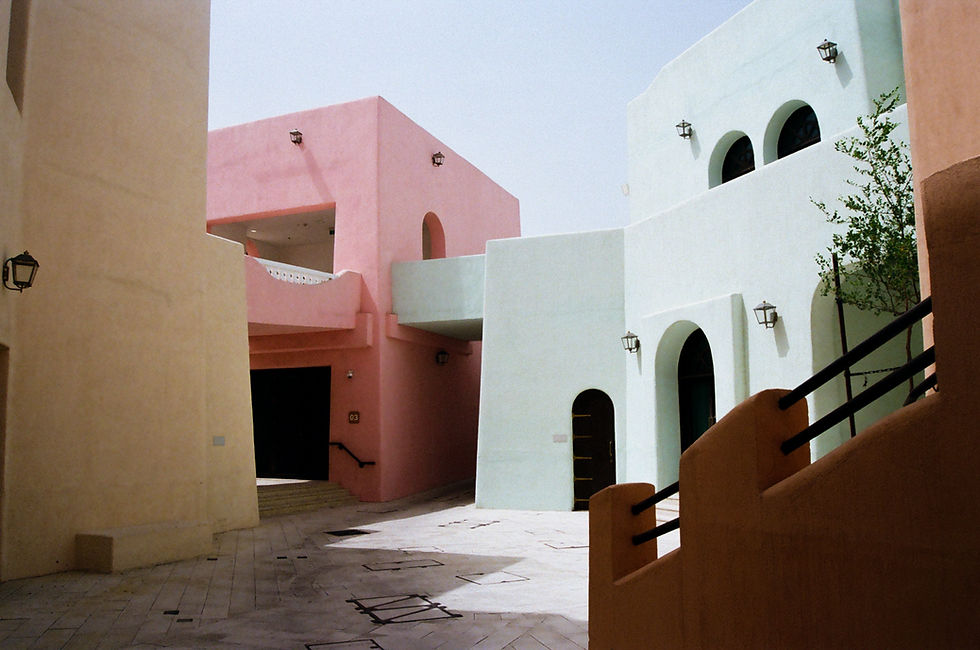
There is more than enough to experience in a short stopover, for sure. You may have seen the highly-Instagrammable pastel coloured houses and cobbled streets of the Mina District, from where you can catch some incredible views of the port, fishing boats and the emerging Doha skyline. Souq Waqif market offers an authentic Gulf experience, with Iranian, Qatari and Lebanese food stalls spilling out onto open-air stone walkways, with jewellery, spices, tea and lamp shops dotting the warmly-lit, busy indoor markets.

Prepare to be blown away by the work that has been done on museums, both inside and out. The Museum of Islamic Art, that sits alone on an island just off the Corniche, is a statement of intent. Sandy coloured and resembling an ancient fort with centuries-old Islamic aesthetics, the MIA is rooted in a deep tradition, all the while looking forward with its sleek symmetry, minimalist lines and precision. Inside, find North African embroidery, Mughal artifacts and Persian tiles.

The National Museum is tough to forget. Inspired by the Gulf desert rose, it's a striking construction of interlocking discs layered and angled like frozen shards or petals. Chaotic, clustered but intricate, the discs’ jagged edges create sheltered courtyard and shaded walkways which help temper the harsh sun. Like the IMA, a well-thought out architectural connection to the environment and heritage is the key theme.

Many come through, but few stay for more than a few days. Is Doha simply a desert mirage on your journey to somewhere else? When we visited (early summertime), there was almost no one out during the day - for good reason. The intense heat (which can easily exceed 40c in the peak of summer and not fall to below 33c during the night) renders the city a ghost town for most of the day. The apocalyptic vibe was completed by a strong, dusty wind and strange white sky that obscured the skyline - all the more adding to the liminality theme. When the desert sun gets all too much, a rooftop swim back at the hotel is always on the cards.

The movement of people within the city changes as night falls - the restaurants, markets and skyscrapers burst into life. In some ways, it's a city built around movement - of people, planes, capital. To this end, it works extremely well. It feels curated for the in-between - a place that few stay long enough to fully grasp. But, describing Doha as a liminal space risks missing something. It's not a city waiting to become, it already has - but it's still young. Doha’s style is polished, quiet (especially when compared with Dubai), yet boldly ambitious and international. It may feel like a stopover, but it's too intentional, and too self-aware to be insignificant. The question is not whether Doha acts liminal, but whether its strategic purpose allows it to be liminal. It's a city that wants to shape what you take with you, and one that is truly, truly impressive.



Comments